Monday, January 9, 2012

ChristmOZ

For our 2 week Christmas break Quinn and I decided a few months ago to go to Sydney, Australia. We left for Apia, Samoa on Tuesday the 20th right after our last session of mid-service. The only places you can fly to from American Samoa are Samoa and Hawaii, so in order to go to Australia we had to fly to Apia first. Our flight to Sydney left early on Wednesday morning so we stayed overnight with some peace corps volunteers who live about 5 minutes from the airport in Apia. The taxi driver who dropped us off at their house offered to come pick us up in the morning to take us to the other airport about 45 minutes outside of Apia, where they have more international flights.

Between going out to dinner with the peace corps people and waking up early for our flight, we didn’t get much sleep that night. It didn’t help that the taxi driver came at 3 am when we had told him to come at 4 am. We had told him that we wanted to get to the airport at 5 am (since our flight was at 7 am) but he had misunderstood and thought our flight was at 5 am.  We made it to the airport with plenty of time to spare since even though it is the “bigger” airport in Apia it still only has two terminals. The 5 and half hour flight was pretty uneventful except we were annoyed that they didn’t give us any food or drink the entire flight. That’s what you get when you buy the cheapest flight I guess.

We were very excited when we landed, but we had to wait for a while to get through customs. And then we found the train we were supposed to take to get into the city. As soon as we got off the train, WOW talk about reverse culture shock! There were tons of people everywhere and they were all walking really fast! There were fast cars driving on the wrong side of the road! Lots of tall buildings and stores and traffic lights and lots of city noises. It was cold and rainy and there we were bumbling around with our huge backpacks, tired, hungry, getting in the way of all the fast, purposeful walkers, not knowing what to do first. Get a taxi (how? They all went so fast!) or find something to eat? We walked around for a while not really sure what to do. We somehow ended up in a mall type place, by which time we had gotten so overwhelmed we just decided to get in a taxi to go to Quinn’s friend, Amie’s, apartment. A kind man explained to us the light system of the taxis so we were able to flag one down.

When we got to Amie’s apartment we dropped off our backpacks and, since no one was home, we decided to walk around to find something to eat.  We found a little cafĂ© to get sandwiches and then explored both of the nearby grocery stores in awe. So many choices! Usually there’s just the tuna/weird meat in a can aisle, the packaged cookie/chips aisle, and the pasta/large jars of mayonnaise aisle. After the grocery store foray we headed back to the apartment to shower and take a nap. I took the first hot shower I’ve taken in 5 months and it was AMAZING. I was difficult to make myself turn off the water and get out after 20 minutes. I then had the best nap of my life curled up under a thick comforter in a super comfortable bed.  So those were the highlights of the first day: the pleasantly cool temperature, grocery stores, and hot water. We continued to enjoy these and more simple pleasures throughout the trip.

Bondi Beach
The first few days in Sydney we explored the city. We saw the bridge and the opera house. We walked around the old part of town called The Rocks where they had a pretty cool market. We also explored the fabulous beaches, including the well-known Bondi (pronounced Bond-eye, not Bond-ee, we learned) and went on a coastal walk from Bondi to Coogee beach, visiting all the beaches in between. Oddly enough we didn’t actually want to spend too much time just sitting on the beach like many other tourists. We’ve been in the sun so much all year round that we wanted an escape, and, although the water was supposedly warm by Australian standards, it felt freezing to us! We explored the cool little beach neighborhoods, and indulged in large servings of frozen yogurt which does not exist in AmSam. Dairy products are hard to come by (we drink ultra-pasteurized milk that doesn’t half to be refridgerated until it’s opened and tastes a little funny), as well as anything frozen, so the combination is truly rare. We tended to get most of our food at the grocery store instead of eating out since Sydney is a pretty expensive city and we were definitely on a budget. One of our favorite food items was passion fruit yogurt which I had never had before but is excellent. We enjoyed it with muesli every morning.
Part of the coastal walk from Bondi to Coogee
 
Vineyards we visited in Hunter Valley
We took a couple day trip to Newcastle where we stayed in a hostel. It’s a smaller city, but still on the coast with nice beaches and a nice coastal walk as well. One of the days we were there we went on a wine tour in Hunter Valley which is famous for Semillon and shiraz wines. Our tour guide, Tex, was a large Australian with a thick accent and good sense of humor so that made it even more fun. We visited a total of 4 wineries, two large ones and two smaller ones, and a cheese shop where we got to sample many delicious cheeses. We learned a lot about the local wines and vineyards and drank a lot of wine throughout the day!

 
Back in Sydney we explored more of the city including the botanical gardens and Chinatown which was filled with tons of cheap stuff so it was definitely the place for us. Christmas and New Years to me felt more like the 4th of July or Memorial day at home than anything else. I’ve never had a Christmas or New Years in a place that wasn’t cold and snowy. But in Australia it’s summer during that time so everyone parties and has barbeques and goes to the beach all day. On New Year’s there were fireworks from the bridge at midnight which were pretty awesome. We watched from the little beach near Amie’s apartment since going into the city would have been madness. We had been there earlier in the day visiting the gardens and there were already huge lines of people waiting to get into certain places, no doubt prime firework viewing spots, at 10 in the morning! Even getting out of the city at around 6 pm was tough because certain streets had been closed off and the buses were rerouted and packed with people. I think we got out just in time!


We were also able to take day trips to the Blue Mountains and to a wild life reserve a couple hours west of Sydney. It was nice to have public transportation that had a schedule and came on time and didn’t stop running at 6pm! At the wild life park we were able to pet kangaroos and koalas and saw a lot of other cool animals like birds, wombats, wallabies, bearded dragons, and penguins. The Blue Mountains were one of my favorite things that we did. The temperature was a lot cooler there and it was perfect for hiking. We saw a lot of beautiful mountain scenery and waterfalls. It reminded me of hiking in Pennsylvania in the fall.

Waterfall in the Blue Mountains
We left Sydney to fly back to Apia on the night of the 1st. It was a long trip that is kind of a blur in my mind because of sleep deprivation. I pretty much had half a seat on the way to Apia because of a large Samoan sitting next to me. We also arrived in Apia just a few days after they had switched time zones, so we got there on the morning of the 2nd which was a Monday. We had a while until our next flight and also had to travel 45 minutes back to the other airport (we had to go back to the other airport because we had originally bought our tickets for the wrong day, not taking into account the time change) so we decided to stop by the market. However, there wasn’t really anyone at the market and everything seemed sort of dead. We even spied a few people who looked like they were going to church, so maybe they still kind of thought it was Sunday the 1st instead of Monday the 2nd. Then we thought we should just head to the airport and we might be able to get on an earlier flight since we had done that a couple times before. The airport seemed kind of like it was closed too. There was one other person waiting there who said he was supposed to be on the 8:30 am flight. We had also heard from someone else that there were supposed to have been flights even before that. Ours wasn’t scheduled until 10:30 so we still held out hope that a plane would come. Confused and exhausted, there was nothing else to do besides take a nap on the bench. After waiting for what seemed like forever, more passengers started showing up and when we saw a pilot walk by we knew we were truly in business! I think our plane probably left around 11 am. I’m not sure what happened to the earlier flights but that’s just how it is in Samoa.

After our 30 minute flight from Apia to Pago Pago it was like we had traveled back in time because it was then the morning of the 1st again. We slept the rest of the day, woke up for a few hours to eat, and then slept the rest of the night. It was good that we got a couple of days to recover before school started again on Wednesday.

All in all it was a fun trip, but I wish I’d had more time and more money to explore some other areas of Australia. I also think the experience was different for me coming from AmSam than it would have been coming from the US. While things like petting koalas are cool no matter where you are coming from, we also immensely enjoyed things like not sweating for an entire day and wandering up and down the aisles of the grocery stores. It’s good to be back but that also means I have to go back to eating tuna and pasta and sweating 24/7.

Tuesday, January 3, 2012

Ready for round two?


With only 3 weeks of the first semester left after Thanksgiving, time just flew by. We had a designated review week before finals, which took place Tuesday, Wednesday, and Thursday on the last week of school. It was hard to keep the kids interested and engaged for a week of going back over material they hadn’t been too excited about in the first place. It got especially exasperating when some kids still didn’t understand at the end of review week or would ask me the day before the exam, “Miss, what’s going to be on the test?” We made it through review week, but I never want to play bingo or jeopardy again!

Even giving the exams was somewhat of a struggle. Each class was allotted a 90 min period to administer the exam, but I knew there was no way these kids were going to be able to concentrate or stay quiet for that long. I made my tests so that they would take no more than an hour (I had some advanced students finish in about 30 min). But then there was the problem of keeping them quiet while others still had their exams and then keeping the whole class relatively quiet during the 90 minutes so as not to disturb the classes around us. Cheating was definitely a problem (they still haven’t figured out I make more than one version of the tests even though I’ve told them), and I caught some students, but I’m sure there were others who got away with it. But, hey, if you cheated and didn’t get caught at least you were smart enough to get that far. Keeping them quiet for the entire 90 minutes was pretty much impossible. I let some kids leave the room to go outside because they were getting so crazy and I didn’t want them to disturb other students. But then I got a phone call: “Hi Abby, um this is Mrs. So and So from across the hallway. Um can you please keep your kids inside the classroom? They are disturbing my students. I hope this doesn’t happen again next period. Thanks.” Yeah, why do you think I sent them outside in the first place? They disturb everyone wherever they go!

So with exams finished on Friday we celebrated with the Christmas pageant and a school dance. The pageant was very similar to past assemblies complete with the 3 world teachers being cajoled into dancing alone (to Dancing Queen of all songs!) while the entire student body watched and cheered. The dance that took place after lunch was slightly odd in the fact that it was happening at 12 in the afternoon and all the kids were dressed in their normal clothes. But in many ways it was very similar to a middle school dance. There were the “cool” kids showing off all their dance moves. There were the clumps of girls and the clumps of guys who wanted to mingle but couldn’t find the nerve. There were the awkward kids circling the outside, wanting the join in but not really knowing how. But, of course, to Samoanize it there were teachers and administrators circling the gym and patrolling the stage carrying big sticks ready to whack the couples who got a little too close (leave room for Jesus!) or break up a fight between villages. A fight actually did break out and then everyone had to sit down and take a breather while they got a talking to.

Technically there was still school the Monday and Tuesday after that but all the WorldTeachers were excused for our mid-service meetings. I doubt there were very many students or teachers who came to school for those days anyway. At mid-service it was great to have the whole group back together again. We hadn’t all been together since the beginning of August, and a lot of people hadn’t seen the teachers in Manu’a since then either. We talked a lot about our feelings (so much fun) and beat to the death the subject of classroom management, but I did actually learn some new stuff, especially from the other science teachers, to revamp my classes for the 2nd semester. Which starts tomorrow!

And so 2nd semester begins whether I’m ready or not. I’m worried the kids might get a little too comfortable with me and our routine and we won’t be able to get stuff done. I’m also hoping I haven’t run out of creative and fun science activities that require little or no materials. I guess we’ll see what happens!

I was going to write about my Christmas vacation to Australia, but I’ll save it for another one because this is getting pretty long. But I now have a new working computer so blogging (along with so much other stuff) will become a lot easier. So stay tuned for “ChristmOZ.”

Sunday, December 18, 2011

Thanksgiving in Manu'a

Manu’a is the name for the outer islands of American Samoa which include Ta’u, Ofu, and Olesega. There are currently 5 world teachers living and teaching on Ta’u and 2 world teachers living on Ofu and teaching in Olesega (the two islands are connected by a bridge). We met and befriended these world teachers in July when we were all crammed into close quarters for orientation, and then they were all shipped off to Manu’a, not to be seen again until the entire group reunited again in December at mid-service. A few of us decided that Thanksgiving would be an excellent time to go visit Manu’a and the teachers living out there. It would be enough time to see everyone and do everything but not too much time to become bored. I have been told several times by Samoans that there is nothing to do in Manu’a besides watch TV.

Getting to Manu’a can be a pretty tricky thing, and even after having gone through the process once now, I really don’t understand it any more than I did before. It seems like it mostly has to do with knowing someone who knows someone else whose cousin’s sister knows someone who works at the airport. That and a lot of persistence and a little bit of luck. The three of us who decided to go starting putting our names on “lists” for flights weeks before the actually flight. Then they would tell us that we were “confirmed” for the flights. I’m pretty sure that no one who works at the airport here actually understands what that word means. They told us it would be best to wait and pay for our tickets later, just in case. Then there is always the problem of the plane breaking down because it breaks down at least once a week. Anyway, many phone calls and “lists” later, I personally, was not 100% confident that we would be traveling to Manu’a until I was in the plane and it was in the air.

Me, Quinn, and Amber with our turkeys!

We were scheduled to leave Pago Pago Wednesday at 11 am. This was also the day of the annual Turkey Run fundraising event at Leone High School. Every year a lot of students, staff, and others who just want to run for a good cause participate in the approximately 4.25 mile run around Leone. The winners (of so many different categories I can’t even count them all) win a giant turkey. I’m pretty sure the amount of money spent to buy all the turkeys for the winners exceeded the amount paid by the participants to enter the race. The race started at 5 am which is before it is even light outside, so Quinn and I figured we could go run the race, pick up our free turkeys, then head home to shower and grab our bags before heading off to the airport, our turkeys in tow. You can’t buy a turkey in a store in Manu’a so pretty much the only way to get one is if your friend or family members bring one to you. At this point you might be thinking, “You can just bring a turkey on a plane with you?” And the answer is, “Yes, of course. This is American Samoa.”

There was one slight kink in the plan, though. When Quinn and I checked in at the airport with our frozen turkeys wrapped in plastic bags and then placed in reusable grocery bags, they told us we couldn’t take them unless they were in a cooler because they would get other things wet. Darn. Then they went into the back room to see if they had an extra cooler for us. Unfortunately, not, which meant we had 30 min to get a cooler or we would have to leave our hard-earned turkeys behind. So while Quinn watched all our stuff, I quick called a cab to take me to the nearby Cost-U-Less, where I purchased a cooler bag that would fit both the turkeys, and then rushed back to the airport just in time. We managed to actually get on the plane and land safely in Ta’u! Of course, we were still a little concerned about getting back even though we were “confirmed” for a flight on Sunday (it is pretty normal for people to get stuck out in Manu’a for days passed when they had originally planned to return), but we were taking it one step at a time. In fact, not long after we arrived in Ta’u we were told that there was no flight on Sunday.  Oh well.
Life in Ta’u is a lot slower, even than life in Leone. There aren’t any taxis or buses so you just have to walk or have friends drive you if you don’t have a car. There are a lot fewer people and a lot fewer dogs. Everything is just a lot quieter and relaxed almost to the point of boredom. The island itself is beautiful and a lot of it is undeveloped or is part of the national park. On our first day there we hiked out to a beach called 2nd beach. Little did we know that there was a convenient path and instead we took twice as long to scramble up and down and around the huge rocks along the shoreline.

2nd beach in Ta'u


One of the bad things about Manu’a is the amount of mosquitos and ants! I thought they were bad here before I got to Ta’u, but this is nothing compared to out there. Putting on bug spray is necessary even when inside the house. And basically our friends there have stopped fighting the ants and have just learned to co-exist. Every food item has to go in the fridge or it will be devoured by the ants, even things that aren’t opened yet. 
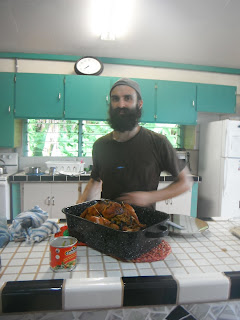
We had Thanksgiving dinner at Cat, Wes, and Mitch’s house which is right next to the elementary school. The two teachers from Ofu came over on a boat on Wednesday for the holiday so we had 10 people altogether. Everyone brought something to share. A lot of it came from boxes, but sometimes that’s the best you can do out here. Wes was in charge of the turkey and it turned out very nicely. We were all happy to enjoy the food and spend the thanksgiving with our friends that we hadn’t seen in so long, even though it’s tough to be away from your family during the holidays.

A Samoan Cocoa

 
Wes with the turkey!


The boat we took to Ofu
On Friday went back to Ofu with the two teachers who live there. We got picked up by their  neighbors who  have a fishing boat and like to fish for tuna. It’s about an hour boat ride from Ta’u to Ofu. Along the way we stopped to do some fishing. They can just follow these certain types of birds that swarm above the water where there are a lot of tuna and then they just let out their lines and drive through the birds. Then they reel in the fish and hit them on the head really hard with a wooden stick to kill them and then toss them in the bottom of the boat where you can hear them flop around for a little while. After reeling some in, they tossed the stick to Erin and asked “Fia sasa?” (“You want to hit?”) So then she took over the whacking of the fish heads. Then one of the fishermen started cutting up a tuna and passing chunks around to eat. I was feeling a bit seasick at the time so I didn’t try any but it looked kinda gross when everyone had raw tuna chunks hanging from their teeth. I tried some when we got back to the house and it wasn’t bad, but I prefer it cooked.


Ofu is the prettiest island that I have been to so far. Its beaches have even been ranked in the top 10 in National Geographic so I’ve heard. The snorkeling there is amazing! It’s the best that I’ve seen since coming to American Samoa. I took a lot of underwater pictures but like I said before, underwater photography is difficult, and the pictures don’t really do it justice. The beaches also had real sand! Many of the beaches on Tutuila and the beaches we went to in Ta’u have really coarse sand or sand that is mostly made up of chunks of coral. 
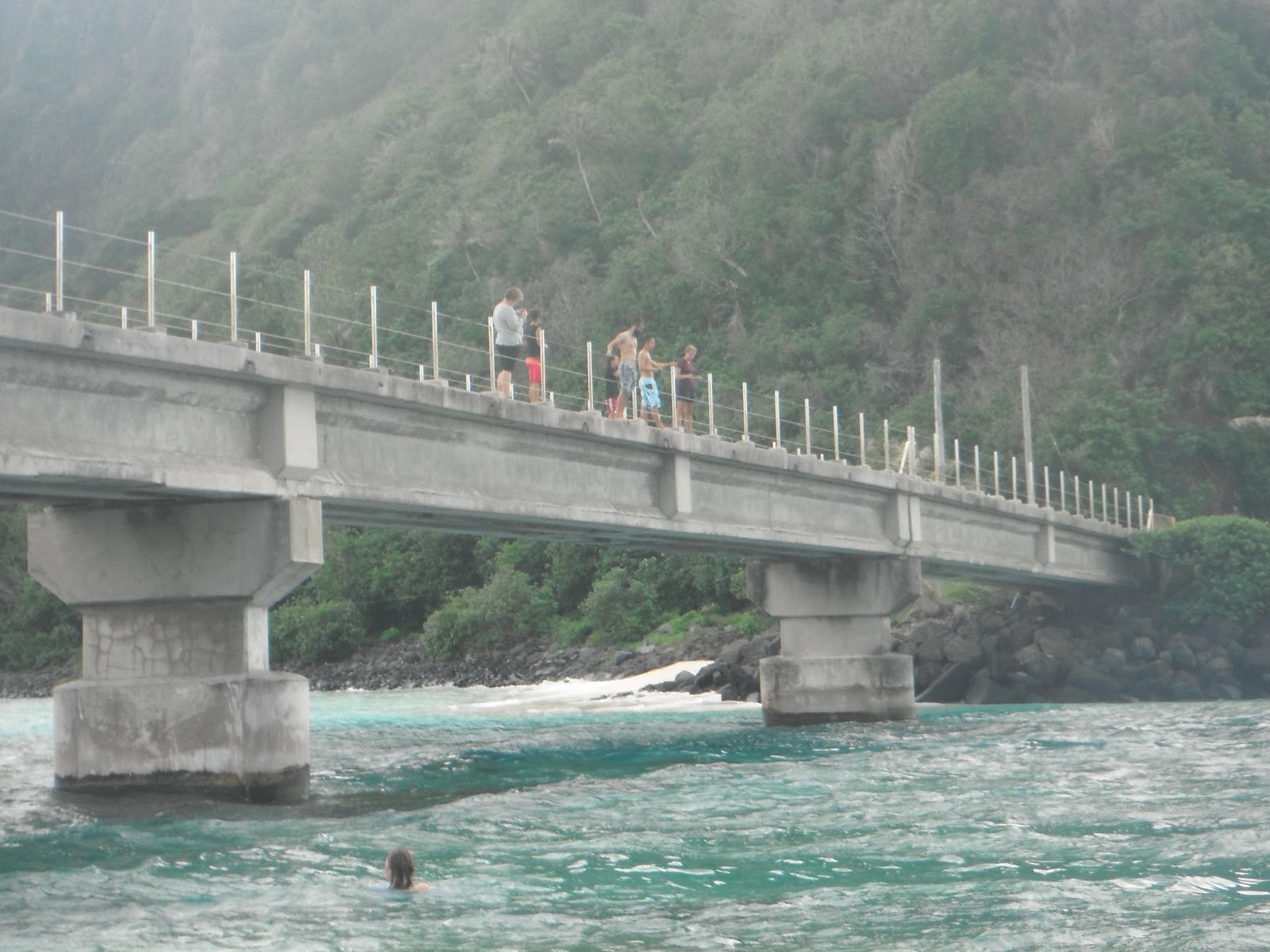
We also visited the bridge that connects Ofu and Olesega. There are only a few people who live on Olesega, but that is where the elementary school is for both islands. Kids from Ofu and Olesega have to go live with relatives in Ta’u or Tutuila to go to high school. The one school bus picks up all the kids on Ofu every day and brings them to the elementary school in Olesega. We crossed the bridge briefly and took a picture next to the welcome sign just to say we had visited another island. The main attraction was the bridge itself. It’s a great place to jump off into the water, but you have to be careful and not jump when the current is too strong or you can get swept away. The bridge doesn’t look that high from the ground, but, of course, it looked a lot higher from the top after stepping under the railing and peeking over the edge.  But it was fun and exhilarating once you could finally convince yourself to do it.


After getting back from Ofu on Saturday afternoon we learned via phone message that we had been “confirmed” for a flight that morning, but had missed it. This meant we would have to be on the standby list for the Monday flight. We called our school Monday morning to tell them we wouldn’t be coming in to teach because we were stuck in Manu’a. They didn’t seem very surprised.
We spent Sunday pretty much doing nothing. Sunday’s there are even worse than Sunday’s here in terms of boredom. We watched a lot of movies and waited until 5pm when we could go get freshly baked bread from the store down the street. In Ta’u you can only get bread on Sundays. You can’t get bread ever on Ofu or Olesega. So this was a special event. The bread was delicious and we even got cinnamon bread!
On Monday morning we headed to the airport hoping we would be able to get on the flight. The only way to find out for sure was to go to the airport and see what happened. The airport people asked why we hadn’t come for the flight on Saturday, but then said we were lucky because some people had canceled for Monday so there was room for us. We made it back only one day later than we had planned which is really not bad for a trip to Manu’a!

Monday, December 5, 2011

Real Frogs?!

Since the beginning of the year I have been asking my students occasionally if there are any activities they would really like to do or things they would really like to learn about. A recurring suggestion in my biology classes was to dissect frogs. I would always reply "Hmm that would be really cool, but I don't know if we'll be able to do it." When it was difficult for teachers to get basic things like chalk, poster board, and printing paper, I doubted I would be able to get all the materials for a dissection. Even if I could find somewhere to get them, the main object would be money. The teachers at Leone pay for most of their classroom materials themselves. At the beginning of the year I got 3 pieces of chalk and a few pieces of poster board. That lasted me about 3 days. As a volunteer teacher I wasn't going to be able to put out the cash for 50 students to dissect frogs.

Then I got an email. WorldTeach was offering grant money to World Teachers in American Samoa who submitted proposals to enhance our ability to support our school and/or our community. It was called a "Community Service Grant" so I wasn't sure frog dissections really fit the description, but with nothing else to do on a Sunday and nothing to lose, I submitted a proposal. A few days later I found out that I had been awarded a grant to pay for frogs and dissection kits for my biology students! Just in case something happened, I didn't tell my students right away, but we started a new unit on amphibians and frogs. I assumed it would take a while for the frogs and kits to come in the mail from the US since everything takes forever here, but it didn't take a long at all. Soon after, I got a text from Drew, our field director, saying my frogs were here.

I opened up the box at our house and right on top was a giant plastic bagged filled with dead, preserved frogs. It grossed out the roommates a little bit. There was also 30 sets of tools and magnifying glasses, and 30 dissection guides, which were written at a level way too advanced for my students. We still had a little bit more work to do to prepare them for the dissection, but I could finally tell them for certain that we were definitely dissecting frogs. "I have 30 dead frogs in a bag in my bedroom!" I told them. To which they responded, "EWWWWW!" "REAL FROGS?!" "Are they dead? Did you kill them?" "Where did they come from??" I had already explained to them that they large toads that are always seen smashed on the road are not actually frogs but toads. I knew a lot of them were excited to do the dissection, but I was pretty sure they didn't really realize exactly what they were getting themselves into, having never dissected anything before.

I prepared them the best that I could beforehand by doing worksheets, drawing pictures, learning the dissection tools and how to use them, and watching a youtube video of a frog dissection (they thought I had filmed myself since the video only showed the hands of the person doing the dissection).You can only get so much out of worksheets and videos. At some point you really just have to dive in and do the dissection. I scheduled it for the Thursday the week before Thanksgiving break (I needed to get this bag of dead frogs out of my room before I left for Thanksgiving) and told them to bring gloves if they wanted them and styrofoam plates to do the dissections on because I couldn't find any dissection trays.


This is me demonstrating incorrect cutting technique.

I was nervous about a few things. First, about my actual dissecting knowledge. I've dissected a lot of things so I wasn't nervous about getting grossed out, but I've only ever dissected one frog and that was about 10 years ago. I was also nervous about being the only teacher in the room while 25 kids who have never dissected anything are cutting open frogs. Amber came to help control the situation for the first period which was helpful. The other teachers were busy teaching and I didn't have confidence in their dissection abilities anyway. I was also worried that they would forget to bring glove or plates (most forgot gloves). I was also concerned about safety since we were using some sharp tools, and I want to make sure that nothing left the classroom. I didn't want kids making shanks out of the scalpels or taking the dead frogs to throw on other kids. I made them all write and sign a contract the day before the dissection which included things like "I will not use the scalpel on my partner, etc." I was expecting some of the kids to feel grossed out, but it didn't even cross my mind that some of them would get physically ill. I guess I've dissected so many things that I'm not bothered by this anymore, but there were a few kids who had to leave and throw up.

When I pulled out the bag of frogs at the beginning of the period, the class erupted with cries of disgust and again I heard, "Miss, are those REAL frogs?!" Kids recoiled when moved the bag anywhere near them. They were even further appalled when I reached my UNGLOVED hand into the bag and pulled out a frog for each pair of students. “Miss! You can touch them with your hands??” Most of them were able to get over it after 5 or 10 minutes. Videos and worksheets can only take them so far in their preparation. A lot of them really got into it and seemed like they started to enjoy it. Some of the highlights were cutting open the stomach to see if there were any distinguishable insects left inside like cockroaches, flies, and grasshoppers, and finding and cutting out the heart. Since there was only one of me and 25 of them, I spent both dissection periods running around the room trying to help every group. I ended the day covered in sweat and frog slime.


The week after, I asked all the students to write a reflection/critique about the dissection. I gave them questions to answer such as what they liked and didn’t like, what they learned, what they would have done differently, how they felt during the dissection, if they would want to do another dissection, etc. I got a lot of interesting essays. Here’s an excerpt:

Well, the frog dissection activity was both disgusting and interesting. At first I was excited and confident, but when Ms. Abby brought out the frog, I was terrified. I was on the verge of throwing up outside the classroom. It took about five minutes for me to calm down…

 But then he goes on and the tone of the essay changes in almost the same way that I observed changes in the students’ behavior and attitudes on the day of the dissection.

I would love to do this activity again someday. Activities like this make me excited to come to school every day. I would love to dissect a real life human body if it is legal. Thank you so much Ms. Abby for such a great experience!!! :)

Overall most kids said it was an exciting and interesting activity that they enjoyed and from which they learned a lot. I was surprised by the number of students who expressed concern that the frog was not really dead and would suddenly jump on them in the middle of the dissection. There were a few who told me that one dissection was enough for them, but most want to move on to bigger and better things! Everything considered I think it was a success from my point of view, as well as that of the students. I’m glad I was able to give them this opportunity!

Sunday, November 20, 2011

Tattoo festival

A man getting a tattoo tapped into his chest
Tattoos or "tatau" have been an important part of Samoan culture for thousands of years. The art declined in the 18th century with the arrival of missionaries, but is still a common and important practice. The tradition tattoo for men starts at the waist and continues to knees, while the traditional tattoo for women is smaller and covers most of the thighs. The traditional method is performed by tapping the ink into the skin. The artists uses a special tool made of a wooden handle with a sharp animal tooth connected to the other end. This is dipped in ink and then rapidly tapped with another stick as it is moved along the skin in the desired line to imbed the ink (I took a video of the proccess but the internet is too slow to upload it). The skin must be held taught and blood and ink must be constantly wiped away from the tattooed area. From what I've heard and observed, it is an extremely painful and long process. Large tattoos, like the traditional ones, must be completed in multiply sessions, and each session may last for hours.


The tapping tools


The tools and techniques have not changed very much over thousands of years, although it is now an option to get tattooed with an electric gun rather than the traditional, and more painful tapping method. It is easier to create smaller details, as well as curved lines with the gun than with tapping.


Traditional women's tattoos

The tattoo festival in American Samoa takes place every October and was started by the owners of Tisa's Barefoot Bar. The festival starts on a Friday night and continues until Sunday aftertnoon. People who have gotten tattoos show them off and there are contests with a variety of categories for all the artists involved in the festival. Anyone can come and get a tattoo as long as they put their name on the waiting list. There are artists who do the tapped tattoos, as well as ones who use a gun.

Wilson, one of the tapping artists there creates very unique and personal tattoos. He likes to get the know the person he will be tattooing and then design something that fits with that person's character and personality. You can tell him where you want it and the approximate size, but after that you just have to faith that he'll create something you'll like.

Kasey getting her tattoo
After being at the festival for about half an hour and watching a lot of people show off their tattoos and get tattoos, Kasey decided she should put her name on the waiting list for a tattoo! "I can always decide not to do it later," she said. But 20 min later, armed with her Vailima, she was getting the outline of her tattoo drawn on with a sharpie. She chose the gun rather than the tapping method but from the look on her face it seemed like it was pretty painful still.

The final product
Her's turned out pretty cool, so then I decide I should get one too--a sleeve covering my left arm. Haha just kidding!! (Don't freak out mom and dad! No ink for me!) I'm not ready for something so permanent, not to mention painful. But they are really interesting to look at on other people.

Friday, November 18, 2011

Parent Teacher Conferences

Even though parent teacher conferences happened a long time ago, I haven’t been able to write about it mostly because of computer and internet problems. But better late than never.
Parent teacher conferences happened the day after our attempted palolo hunting. We got back at about 3 or 3:30 am and I had to get up for school about 3 hours later. Those of you who know me, know that I do not do well on less than 9 hours of sleep. So that morning I was even more Crabby Abby than usual, and I basically had no idea what to expect at school that day.
What happens is that the kids get their grade sheets in their first periods and then they go to all their classes and the teachers fill out grades and comments for each student every period. This was stressful for a number of reasons. The kids didn’t have a lesson so a lot of them were just roaming around the classroom looking for trouble. Meanwhile, I was hurriedly trying to fill out all the grade sheets before the bell rang for the next period because all the periods had been shortened. This was especially bad in the classes I had 25 or 26 kids.
During the process, I also noticed that previous teachers would write “fail” instead of simply “F” or write “minus” instead of a simple “-“. I was slightly curious about this, but in my frazzled and hurried state, I didn’t give it much thought. Well, I learned later (after I had filled out all my grade sheets) that teachers do this so that kids can’t turn an “F” into a “B” or a “-“ into a “+”. Interesting. Oh well, too late now.
The grade sheets also asked for the number of absences from each student. At the beginning of the day I started filling this out, but after several arguments with students about how many days they had missed (stupid because neither side had any hard evidence) and noticing that a lot of teachers just left these spots blank, I stopped filling it out. At least next time progress reports come around, I will be prepared.
Since the periods were shortened, all the kids went home after lunch. The teachers had to wait around until 3 pm for the conferences to start. Too tired and hot, to do anything. I put 3 desks side by side and took a nap under Quinn’s most powerful fan. It was not very refreshing.
Me at PTC
The conference took place in the gym. The first time I saw the gym I thought it was weird that it didn’t have walls. It’s just a big cement floor with a roof over it. But I guess this makes sense when the worst weather you have to deal with is rain and the temperature doesn’t get below 76 degrees. (80 degrees or below is cold and everyone puts on sweatshirts. For me, this is the only time I stop sweating.) If the gym had walls it would probably be more of a large sauna. Anyway, there were long tables and chairs set up in the gym starting at 3pm. Parents were supposed to come between 3 and 5pm, pick up their child’s report at the main table, and then make their way to each teacher, who were sitting by grouped by subject.
Most of the parents that came to talk to me were the parents of the students who were doing well in my class. I think I only saw one parent whose child had below a B. This is probably a universal trend for parent teacher conferences. The biggest concern of most parents was whether their child was behaving in class and being respectful. Respecting parents, teachers, and older people in general is a very important part of Samoan culture. None of the parents asked me about the content or curriculum of what I was teaching. Most conversations were very short and went along the lines of “Hi, nice to meet you. Your son is doing very well. He’s one of my best students. He’s very respectful.” But one mother decided she needed to tell me the entire life story of her daughter. So I just listened and nodded and smiled a lot.
I only saw about 20 parents out of my 110 students. Talking to other teachers, this is a pretty typical turnout, even on the high side. After talking to my students the next day I found out that a few parents had come to the conference but had not come to talk to me while they were there. As I was not especially busy (only 20 parents in 2 hours), nor especially hard to identify (I am one of 3 white, female teachers), I suspect they may not have approached me because they felt uncomfortable or unable to speak to me in English. There’s nothing really I can do about this, but I’m glad they at least came to talk to the other Samoan teachers.
After being here for over 4 months, it’s become apparent that most parents are not very involved in their children’s education. There is a lot of pressure from parents to get good grades but beyond that I don’t think there’s much communication about school. Students are told to pay attention to the teacher and do their work. I think this may be because most parents don’t really know where to start to help their child because they were a victim of the poor education system themselves. It’s a struggle sometimes to be one teacher fighting to impact the education of so many students. Changes definitely happen slowly.

Sunday, November 6, 2011

Western Samoa

About a month ago during a 3-day weekend I traveled to Western Samoa with a few other World Teachers. Western Samoa is made up of two islands, Upolu and Savi’i (one of the biggest islands in Polynesia), which lie just to the west of the main island of American Samoa, Tutuila. Tutuila is actually closer to Western Samoa than to Manu’a, the outer islands of American Samoa. Western Samoa is officially the Independent State of Samoa, but everyone in American Samoa refers to it as Western Samoa or just Western. While America Samoa is more supported and influenced by the United States, Western Samoa is more influenced by New Zealand and Australia which has created differences in their cultures.
The tiny little plane we flew on.
We left for Apia, the main city located on Upolu, on Friday right after school. The airport here is so small and laid back that you could probably show up 10 minutes before your flight and still be ok. In fact, you could probably show up 10 minutes late. Our flight was scheduled to leave at 4:40 but we didn’t board until a little after 5. After checking our bags (the plane is so small that you have to check everything except what you can literally fit between your feet), we sat in the waiting area. I was expecting to have to go through some kind of security or something but we didn’t and I could even take my water bottle with me. The security guard came and sat with us and it turned out he was the son of someone that one of the other teacher’s I was with knew. When it was finally time to board we said goodbye to our new friend the security guard and walked outside and boarded the tiny plane. The plane is so small that when you check in they weigh you with your carryon luggage to determine where you should sit so the weight of the plane is balanced. My seat was in the very front, right behind the copilot, but I made the rookie mistake of boarding the plane almost last so I had to squeeze through a row of Samoans up to the front.
The cockpit of the plane was open and since I was sitting right behind the copilot I could see everything the pilot and copilot were doing and see out the front window. I discreetly tried to take pictures of the pilot while he was flying, but I’m sure I looked like a dumb tourist to the rest of the passengers. The plane ride got a little bumpy at times since the plane was so small but it was only about a 30 minute flight so it wasn’t that bad.
When we arrived in Apia we had to go through customs since we were technically entering a different country, but basically all they did was glance at and then stamp our passports. We were then on the search for the hostel we had booked for the night. Thanks to Lauren, who had the foresight to bring along a travel guide book with maps, we thought we could just walk from the airport. It turns out there are two hostels with the same name and we walked to the wrong one. But it was ok because they were owned by the same people and they just let us pile into their van and drove us the rest of the way.
We checked in to our very basic and very cheap accommodations for the night. Quinn and I got upgraded to a room with a bathroom and shower (woohoo!). But the shower turned out to be a small trickle of water coming from metal tube above my head. You get what you pay for. Anyway, we were very excited to eat at the Indian restaurant up the street that had been highly recommended to us. The food was excellent. For us, any variation from the norm of pasta, tuna, sandwiches, and cereal is cause for a celebration.
The next day we explored Apia and the giant crowded market. We had come on White Sunday weekend which is the busiest time of year in Apia. But even on a normal day Apia is a much busier place than we had experienced in the past 3 months. It was pretty overwhelming. White Sunday is kind of like Mother’s and Father’s day only for kids. And they wear white. I asked some students why they wear white and they said they didn’t know. This is a typical response when I asked them questions about anything, or else they just make something up. The market in Apia is huge compared to the market in Pago Pago. They sell all sorts of food items as well as jewelry (a lot of it made from coconut shells) and clothing.
We had a lunch of fish and chips at the market because it had been recommended by some friends. A little Samoan boy from the table next to us became very interested in the oasis of white people that had just sat down next to him. He kept wandering over and sticking out his chubby little finger and saying “Palagi” and then we would smile and laugh. Eventually he decided it would be a good idea to pull up chair and join us so he dragged over his plastic chair from his table and situated it between me and Lauren. I gave him a few of my French fries. When he wanted some more he would hit my arm and say “Palagi” so that’s how it went until my fries were gone. I tried out some Samoan phrases on him but he would just stare blankly with his big eyes and munch on his fries. He was sad when we had to leave.


After lunch we headed to the big bus station to catch a bus to our next destination: Lalumanu, over on the east side of Upolu. It turns out that the bus was full and by talking to the locals we discovered that we had the option of waiting for the next one which would come in 2-3 hours (maybe…) or taking a taxi. Since there were 4 of us, we opted for the taxi. It was about a 1.5 hour ride on roads winding through the undeveloped, lush, tropical land of Upolu. Upolu is a lot larger than Tutuila and it was very noticeable how much more undeveloped land there was. We saw a lot more vegetation and even saw some cows! (I’ve seen a total of one cow on Tutuila, although my students tell me there are more.)
This photo looks exactly like the picture on the Roxy ad.

We stayed for 2 nights at Taufua beach fales in Lalumanu, which is basically a bunch of open and closed fales located right along the beautiful beach. The beach is so picturesque it’s like something you would see on an advertisement for Herbal Essences or something. And later we saw an ad for Roxy posted on the wall of the main fale which showed a photo that had been taken in Lalumanu. This confirmed that we were actually in tropical paradise, or at least what advertisers at Roxy think is a surfer’s dream.


We stayed in an open fale, which means that there were no walls, just tarps that could be pulled down and we were sleeping about 15 feet from the ocean so we could hear the waves all night long. Also included in the deal was breakfast and dinner every day, as well a lunch on Sunday. During meals all the guests sat together at a long table and delicious food was brought out by the staff, one delicious dish after another. We got to meet a lot of the other guests, many of whom were from New Zealand.


The delicious lobster course we ate on Saturday night.

Saturday night was fia fia night which means “happy.” There was a performance of traditional dancing and fire dancing. Of course it was all done just for all of us tourists watching, but, hey, I’m allowed to do touristy things. At the end it turned into a giant dance party and everyone in the audience was invited and encouraged to join.


During the day we did a lot of swimming, snorkeling, and relaxing on the beach while drinking out of coconuts. There were a lot of different kinds of fish that were cool to see but almost all of the coral was dead. Lalumanu got hit pretty hard by the Tsunami 2 years ago which killed a lot of the coral and destroyed all the fales along the beach. I tried out my underwater camera for the first time while I was there. I knew that the camera was made to go underwater, but I was a little nervous the first time I put it in the water! It turns out that underwater photography is a lot harder than you might think. You can’t really see the camera screen while you are taking photos so I would just kinda point and hope I was getting what I wanted. I think the key is to just take a ton of photos so that when you delete the bad ones you still have a few good ones left.
We left Lalumanu on Monday in the late morning to drive back to Apia and catch our flight back to Tutuila. I was sad to leave the relaxing atmosphere knowing that I was heading back to the craziness of teaching, but I hope that I’ll be able to go back before my year of teaching here is done.